“The Impact of Artificial Intelligence in Modern Classrooms”
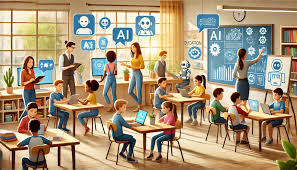
“The Impact of Artificial Intelligence in Modern Classrooms”
In the past decade, artificial intelligence (AI) has transitioned from a futuristic concept to an integral part of educational environments around the globe. By automating routine tasks, personalizing instruction, and offering novel forms of engagement, AI is reshaping how teachers teach and how students learn.
One of the most visible applications of AI in classrooms is adaptive learning platforms. These systems analyze each student’s performance in real time—tracking response times, error patterns, and conceptual misunderstandings—to dynamically adjust content difficulty and presentation style. A learner struggling with algebraic equations, for example, might receive additional scaffolded practice problems and interactive hints, while a student demonstrating mastery can be challenged with extension tasks or project-based activities. This level of customization not only optimizes individual learning trajectories but also frees teachers from labor-intensive differentiation, allowing them to focus on higher-level mentoring and group facilitation.
Beyond personalization, AI-driven automated grading and feedback tools are transforming assessment practices. Machine-learning algorithms can evaluate multiple-choice quizzes, short-answer responses, and even essays with surprising sophistication—identifying grammatical errors, assessing argument structure, and flagging areas needing clarification. Instant feedback helps students correct misconceptions immediately, rather than waiting days for returned assignments. For educators, AI grading reduces administrative overhead and provides analytics dashboards that highlight class-wide trends, enabling data-informed adjustments to lesson plans.
Another frontier is intelligent tutoring systems (ITS) and chatbots, which offer on-demand support outside traditional classroom hours. These virtual assistants field student inquiries, suggest resources, and even simulate Socratic dialogue to deepen understanding. Their 24/7 availability is particularly beneficial for learners in different time zones or those balancing school with work or family responsibilities.
In STEM fields, AI-powered simulations and virtual labs allow learners to conduct experiments in safe, cost-effective digital environments. Biology students can explore cellular processes at the molecular level; physics learners experiment with virtual pendulums and circuit components. Such immersive experiences promote hands-on inquiry without the logistical constraints of physical lab setups.
However, the integration of AI in education also raises ethical and practical challenges. Concerns about data privacy, algorithmic bias, and the digital divide demand careful attention. To ensure equitable access, schools must invest in reliable infrastructure and offer professional development so teachers can deploy AI responsibly. Additionally, overreliance on technology risks diminishing interpersonal interaction, underscoring the need for balanced, blended learning models that preserve the human element of teaching.
Looking ahead, the synergy between AI and pedagogy promises further innovation. Natural-language processing will enable more nuanced dialogue between students and machines; predictive analytics will help identify at-risk learners before they fall behind; and AI-curated content libraries will offer ever-richer multimedia resources. Ultimately, when harnessed thoughtfully, AI has the potential to foster more engaging, efficient, and inclusive education—preparing today’s students for the complex, technology-driven world of tomorrow.